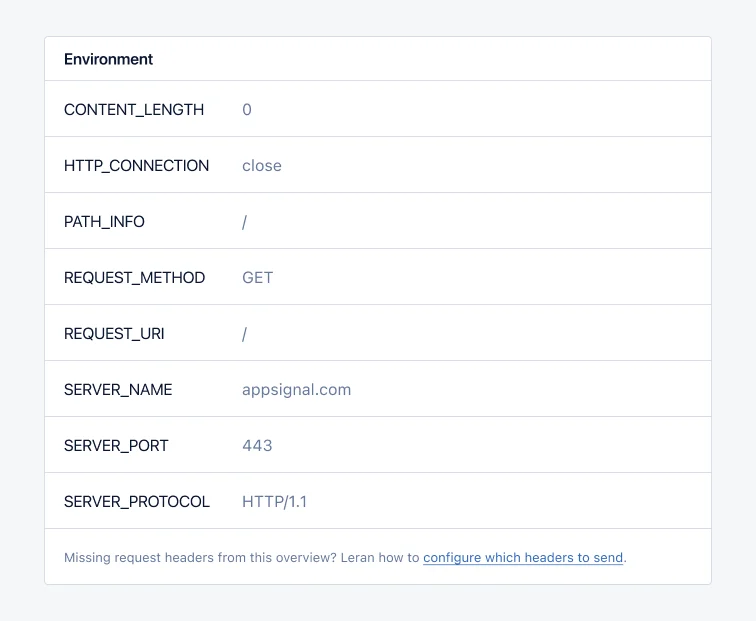
By default, the AppSignal integrations track request HTTP headers for web applications in supported libraries.You can set custom request headers on a transaction or span. Modifying the request headers will overwrite the data set by the AppSignal instrumentations.All request headers are filtered by our integrations before being sent to our servers.
🔐 Do not send Personal Identifiable Information (PII) to AppSignal. Filter PII (e.g., names, emails) and use an ID, hash, or pseudonymized identifier instead.
import { setHeader } from "@appsignal/nodejs";setHeader("request_method", "GET");setHeader("path_info", "/some-path");
from appsignal import set_headerset_header("request_method", "GET");set_header("path_info", "/some-path");
// Additional setup is required to first fetch or create a new spanspan.SetAttributes(attribute.StringSlice("http.request.header.content-type", []string{"application/json"}))span.SetAttributes(attribute.StringSlice("http.request.header.custom-header"), []string{"abc", "def"})
import io.opentelemetry.api.trace.Span;import io.opentelemetry.api.common.AttributeKey;import java.util.Arrays;// Additional setup is required to first fetch or create a new spanSpan span = Span.current();// Set single header valuesspan.setAttribute("http.request.header.request-method", "GET");span.setAttribute("http.request.header.path-info", "/some-path");span.setAttribute("http.request.header.content-type", "application/json");// Set header with multiple values (array)span.setAttribute( AttributeKey.stringArrayKey("http.request.header.custom-header"), Arrays.asList("value1", "value2"));
<?phpuse Appsignal\Appsignal;// Set single header valuesAppsignal::addHeaders([ 'request-method' => 'GET', 'path-info' => '/some-path', 'content-type' => 'application/json',]);// Set header with multiple values (array)Appsignal::addHeaders([ 'custom-header' => ['value1', 'value2'],]);
For certain languages, additional setup is required.
Please follow the instructions for these languages:
Only the last value for a request header is stored if the application sets a request header multiple times.For Elixir, if the helper is called multiple times, only the last set of request headers (environment) is stored.
Was this page helpful?
⌘I
Assistant
Responses are generated using AI and may contain mistakes.